GTA 6 vs GTA 5 Graphics COMPARISON
GTA 6 vs GTA 5 Graphics: The Revolutionary Leap That Redefines Open-World Visual Fidelity
In the sprawling annals of video game history, few franchises have etched themselves into the cultural zeitgeist quite like Grand Theft Auto. From the pixelated heists of the early 2000s to the sun-soaked satire of Los Santos, Rockstar Games has consistently pushed the boundaries of what digital worlds can evoke. Yet, no comparison stirs the soul of gamers quite like GTA 6 versus GTA 5. Released a decade apart—GTA 5 in 2013 and GTA 6 slated for November 19, 2026—the duo represents not just technological evolution, but a seismic shift in how we perceive immersion, realism, and the very artistry of virtual storytelling.07
This article delves deep into the graphics of these titans, exploring the legacy of GTA 5‘s groundbreaking visuals, the tantalizing previews of GTA 6‘s photorealistic prowess via official trailers, and a side-by-side dissection of every pixel, polygon, and ray-traced reflection. Drawing from exhaustive technical analyses by experts like Digital Foundry and official Rockstar releases, we uncover why GTA 6 isn’t merely an upgrade—it’s a reimagining of the open-world genre. Whether you’re a veteran crime lord reminiscing about Vinewood or a newcomer eager for Leonida’s neon underbelly, prepare for a narrative journey through light, shadow, and silicon sorcery that spans over 2,000 words of pure graphical enlightenment.
The Enduring Legacy of GTA 5: A 2013 Benchmark That Still Shines
When Grand Theft Auto V roared onto consoles in 2013, its graphics were nothing short of revolutionary. Powered by an evolved iteration of Rockstar’s proprietary RAGE engine (often referred to as RAGE 7 in technical circles), the game delivered a living, breathing Los Santos that felt alive under the California sun. At launch on PlayStation 3 and Xbox 360, it streamed vast open-world assets with seamless level-of-detail (LOD) scaling, occluding distant skyscrapers to maintain frame rates while rendering intricate urban sprawls up close. Textures popped with surprising fidelity—cracked sidewalks glistening after rain, palm fronds swaying in the breeze, and vehicle paint catching specular highlights that made every stolen supercar feel premium.48
Lighting was a standout: dynamic time-of-day cycles bathed the world in volumetric god rays, with soft shadows and ambient occlusion creating depth without the hardware ray tracing of today. Character models, while less detailed by modern standards, featured expressive animations—Michael’s weary gait, Trevor’s unhinged snarls—that sold the narrative through subtle skin shaders and cloth physics. Water in the Pacific reflected the sky with convincing ripple effects, though it lacked the refractive mastery we’ll see later. Vegetation and environments scaled impressively, from dense forests to arid deserts, thanks to procedural generation hints and aggressive culling.
Fast-forward to the 2022 Enhanced & Expanded editions on PlayStation 5 and Xbox Series X/S, and GTA 5 received a glow-up: native 4K (or dynamic equivalents), 60fps performance modes, and even ray-traced global illumination and reflections on PC ports in 2025 updates. These enhancements hinted at GTA 6‘s ambitions, proving Rockstar’s engine could age like fine wine. Yet, even in its prime, GTA 5‘s visuals prioritized scale and gameplay fluidity over hyper-realism. Draw distances were vast but occasionally revealed low-res assets at extremes, and character faces lacked the pore-level detail that defines today’s AAA benchmarks. It was a masterpiece of its era, blending arcade accessibility with cinematic polish that influenced everything from Red Dead Redemption 2 to modern open-world rivals.56
7Ky7q”LARGE”
LhJg9″LARGE”
As one observer noted in early Digital Foundry face-offs, the engine’s strength lay in its bespoke streaming and scripting, allowing mini-games like golf and tennis to feel integral rather than tacked-on. GTA 5 didn’t just look good—it felt alive, a sandbox where graphics served satire and chaos in equal measure.
GTA 6 Emerges: Trailers That Ignite a New Era of Expectation
Fast-forward to December 2023 and May 2025: Rockstar dropped two cinematic trailers for GTA 6, each a masterclass in in-engine capture. Shot on PlayStation 5 hardware, Trailer 2 (the more recent) runs internally at approximately 1440p (2560×1152 with letterboxing for a cinematic 20:9 ratio) and upscales to 4K at 30fps using a spatial technique akin to early FSR. It’s not native 4K perfection, but the fidelity is astonishing—proof that the latest RAGE iteration (evolved beyond the RAGE 7 of GTA 5) is built for current-gen consoles without compromise.45
The visuals scream photorealism with stylized flair: neon-soaked Vice City (reimagined as Leonida’s vibrant heart), crystal-clear ocean waters teeming with marine life, and characters whose sweat-beaded skin catches light like never before. Digital Foundry’s exhaustive breakdown hailed it as “one of the most detail-rich presentations I’ve ever seen,” praising per-pixel ray-traced global illumination (RTGI) for lifelike indirect lighting—bounces that paint walls in sunset hues without flicker or artifacts. Reflections on glass, water, and even beer bottles capture bubbles, sloshing liquids, and ambient glows with hybrid ray-traced and screen-space precision.36
Hair rendering leaps forward with strand-based simulation for dynamic curls and arm fuzz, while skin shaders render specular highlights on wet backs and furrowed brows. The trailer teases a world where every puddle reflects the sky, every palm leaf sways with physics-driven grace, and distant horizons maintain clarity that dwarfs GTA 5‘s LOD pop-in.
S586H”LARGE”
2Ldpd”LARGE”
7KS8K”LARGE”
These aren’t mere cutscenes; analysts confirm much of the footage is real-time gameplay-adjacent, captured in-engine. With release pushed to November 2026 for “the level of polish you deserve,” GTA 6 promises to eclipse its predecessor not through brute force, but through refined artistry.
Head-to-Head: Dissecting the Visual Chasm
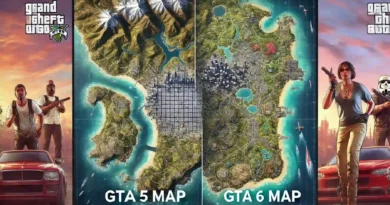
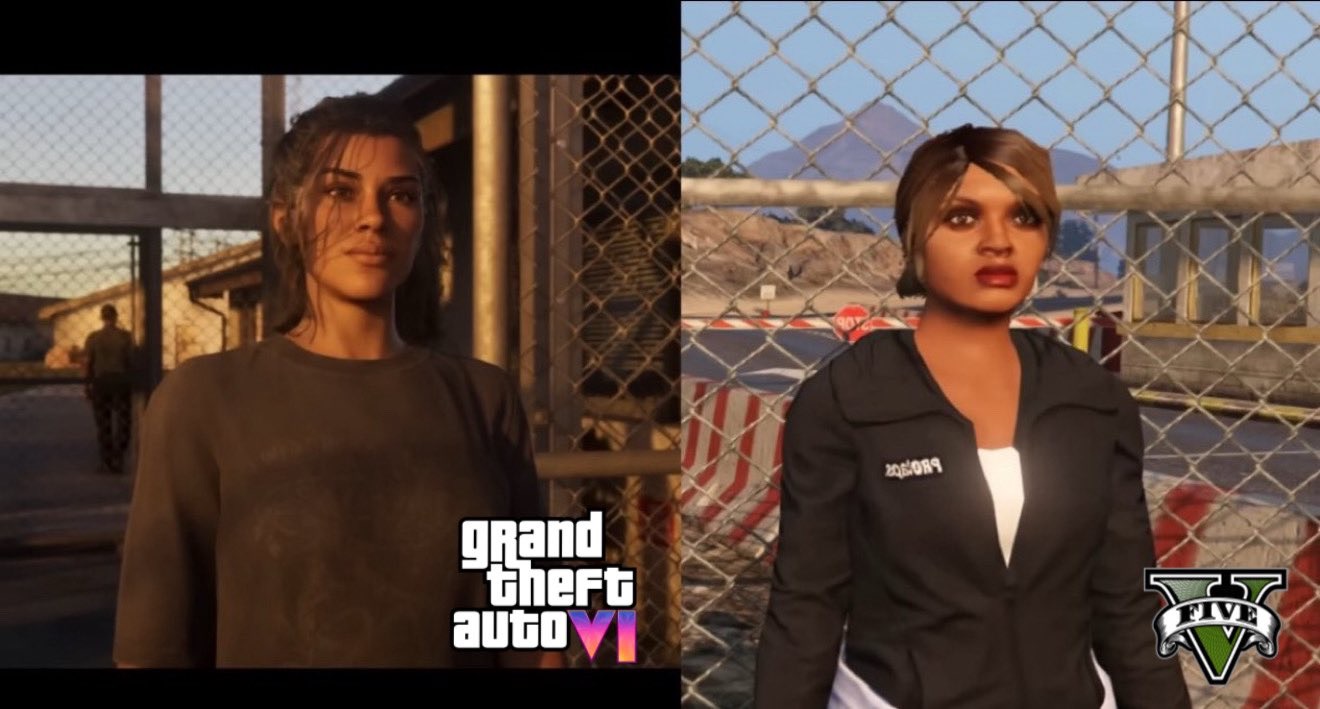
Side-by-side, the gulf is staggering—a 13-year technological chasm bridged by RAGE’s relentless evolution.
Character Models and Animation: GTA 5‘s Trevor, with his weathered but somewhat stiff features and basic cloth sim, pales against GTA 6‘s Jason. Sweat glistens realistically on Jason’s skin, arm hair catches the breeze, and facial pores convey emotion with uncanny subtlety. Lucia’s dynamic hair whips naturally, far beyond GTA 5‘s flatter animations. Clothes drape with secondary physics, and new art direction adds sleek realism without losing Rockstar’s satirical edge.46
bWtEo”LARGE”
Lighting and Global Illumination: GTA 5 relied on baked and dynamic lights for solid but limited bounces. GTA 6 deploys RTGI for true indirect diffusion—sunlight filtering through foliage, neon reflecting off wet streets, evening glows casting colored hues. Shadows use traditional maps for efficiency but pair with variable penumbras for soft edges. The result? A world that breathes light organically, free of GTA 5‘s occasional harshness.45
Textures, Materials, and Environments: GTA 5‘s roads and buildings, impressive in 2013, now reveal clunky polygons on close inspection—lumpy landscapes and dated grass. GTA 6 offers hyper-detailed coral reefs, crystal-clear waters with marine plants, and flawlessly modeled structures. Vehicles gleam with deeper paint reflections, wheel details, and license plate wear. Vegetation sways with individual leaf physics; draw distances swallow horizons without compromise.19
MFlhD”LARGE”
9CWWf”LARGE”
Water and Physics: GTA 5‘s oceans were functional but cloudy and barren. GTA 6 delivers refractive masterpieces—ripples, caustics, and underwater life rendered in real-time. Explosions, crashes, and liquid simulations (even in bottles) showcase polygon-heavy deformations and procedural interactions, promising more realistic accidents than GTA 5‘s solid but simpler ragdolls.13
Performance Nuances: GTA 5 scaled beautifully across hardware, hitting 60fps on enhanced consoles. GTA 6‘s RT-heavy approach likely locks at 30fps on base PS5 for fidelity, with 60fps modes potentially sacrificing some rays— a trade-off Digital Foundry deems worthwhile for the “stand-out technical accomplishment” of the generation.45
The RAGE Engine: From GTA 5‘s Foundations to GTA 6‘s Apex
At the heart beats RAGE—Rockstar’s in-house powerhouse. GTA 5‘s version excelled in asset streaming and memory management under 2013 constraints. GTA 6‘s (RAGE 9 evolution) integrates hardware-accelerated ray tracing, advanced procedural generation, and CPU optimizations for denser worlds. Vehicle physics gain polygon precision for customizable handling; AI-driven NPCs react with lifelike subtlety. It’s not Unreal Engine 5 flash—it’s tailored mastery, hinting at seamless interiors, reactive environments, and narrative depth that graphics amplify rather than overshadow.26
Recent GTA 5 PC ray-tracing patches serve as a blueprint, foreshadowing GTA 6‘s path-traced potential on high-end rigs.
Immersion Redefined: How Graphics Elevate Gameplay
Beyond pixels, these upgrades transform play. GTA 5 made chaos cinematic; GTA 6 promises visceral empathy—feeling the humid Vice City air through sweat-slicked protagonists, hearing waves crash with acoustic fidelity tied to visuals. Exploration becomes tactile; heists unfold in worlds where light and shadow hide secrets or betray positions. The satire bites harder when environments mirror our own with uncanny accuracy.
Conclusion: A New Chapter in Gaming’s Visual Odyssey
GTA 6 vs GTA 5 isn’t a fair fight—it’s a coronation. Where GTA 5 built empires on clever engineering, GTA 6 crowns them with ray-traced majesty, strand-simulated humanity, and an open world that pulses with unprecedented life. As we await its November 2026 dawn, one truth endures: Rockstar doesn’t just iterate; it inspires. The graphics aren’t the game—they’re the gateway to unforgettable stories in a Vice City reborn.
In an industry racing toward photorealism, GTA 6 reminds us that true beauty lies in worlds that feel lived-in, chaotic, and utterly human. Buckle up—the next-gen heist begins soon.